

44 years. It has been 44 years since Louise Brown was born on July 25, 1978.
However, her truly remarkable story began months before her birth with her conception. Louise Brown is the first human born via in vitro fertilization (IVF).
There are many reasons that someone experiences infertility and, as we know, it impacts 1 in 8 families1. Some of these causes include advanced maternal age, requiring an egg or sperm donor, endometriosis, or a desire not to pass on an inherited genetic disorder. In the case of Louise Brown, her mother had blocked fallopian tubes. Since Louise’s birth, there have been millions of healthy babies born via IVF to many different couples with a multitude of reasons for infertility.
So, how does IVF work? To understand this, we need to brush up on the ovulation process first.
If you recall from biology, the process of ovulation is a conversation between the brain and the ovaries; they communicate via certain hormones. The pituitary gland releases the first hormone, FSH (follicle-stimulating hormone). This encourages oocytes (eggs) to grow and mature. The ovaries then send a message back to the brain via estrogen, telling the pituitary gland to stop making FSH, and to begin making LH (luteinizing hormone). LH causes the most mature oocyte to be released and released in to the fallopian tube. This is when ovulation occurs, usually 10-16 days before someone experiences a period. It is at this point a pregnancy may occur if a sperm reaches and fertilizes this mature oocyte. If fertilization and implantation does not happen, a period will occur.
The process of IVF (not so) simply mimics ovulation.
To begin the IVF process, a few tests may need to be conducted for egg and sperm quality and quantity checks. For the eggs, this may be done through ovarian reserve testing, which measures certain hormone levels in your blood during the first few days of your menstrual cycle, in addition to an ultrasound of your ovaries. As for the sperm, a semen analysis will be conducted. Other tests may include a uterine exam and screening for certain disorders for both partners.
Once your physician has given you the thumbs up, you can begin the process! Let’s explore the steps of IVF in a bit more in detail.
Ovarian Stimulation
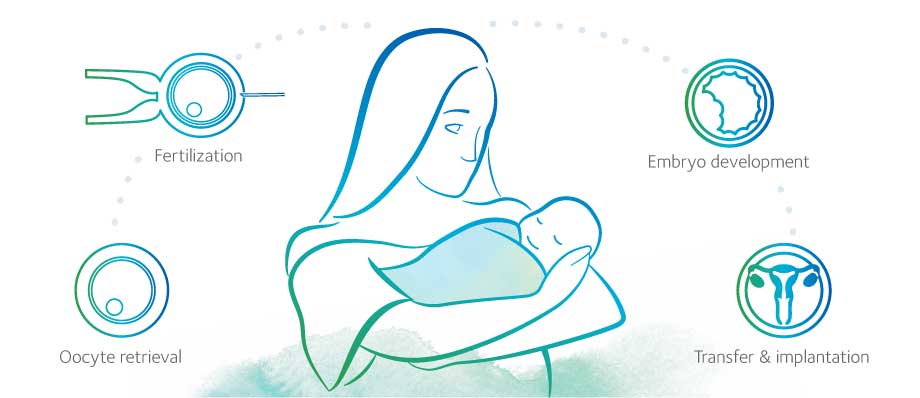
To mimic an ovulation cycle, hormone medications are given to stimulate the ovaries to produce many follicles (these are the sacs that house the eggs). The goal of this stimulation process is to safely obtain as many eggs as possible, as not every egg will result in an embryo for transfer (see step 5). This process usually takes 1- 2 weeks and includes frequent monitoring via vaginal ultrasounds and/or blood tests. These will help guide your fertility team as to when your body is ready for the next step – the trigger shot. The trigger shot is usually hCG (human chorionic gonadotropin) and results in the eggs undergoing the final maturation process in preparation for ovulation.
Oocyte (Egg) Retrieval
The timing of this step is crucial, as it must happen before ovulation occurs, so it is typically scheduled 34-36 hours after the trigger shot. Typically, this process is guided by ultrasound, allowing your fertility team to collect as many oocytes as possible. You will likely receive anesthesia before the procedure. After the oocytes are retrieved, they are kept in the embryology lab awaiting insemination.
Insemination/Fertilization
Many sperm may be placed in the same dish as the eggs. With this method, usually called conventional insemination, sperm swim to the egg and fertilization occurs. Alternatively, sperm may be inserted directly into the oocyte via intracytoplasmic sperm injection (ICSI). This is often done for those with male factor infertility. Prior to beginning your IVF cycle, your doctor will likely discuss the fertilization technique recommended for your case.
Embryo Development
When a mature oocyte is fertilized, it is called a zygote, which then develops to form an embryo. Embryos are usually grown until the cleavage stage (usually day 3 after retrieval) or until the blastocyst stage (usually day 5 or 6 after retrieval). The amount of time your embryos will be grown in the lab prior to transfer (see step 5), will likely be discussed with you before beginning your IVF cycle. If genetic testing is to be done, like PGT-M for single gene disorders, PGT-A for chromosome screening, or PGT-SR for chromosomal structural rearrangements, embryos are typically grown to blastocyst stage, as a trophectoderm (the outer layer of cells of the embryo) biopsy is usually needed for this. The biopsied cells will be sent to the designated preimplantation genetic testing laboratory for analysis. As testing is being conducted, the embryos will be frozen in the embryology lab; this is known as cryopreservation.
Embryo Transfer
When it is time for transfer, you may undergo a fresh transfer (embryo(s) not previously cryopreserved) or a frozen transfer (embryo(s) that has been frozen and is then thawed for transfer). Your doctor will likely discuss with you the type of transfer that is recommended for your case before you begin your IVF cycle. One note – if you are having genetic testing performed for your embryos, you will very likely have a frozen transfer, as the results take up to a couple of weeks and embryos are frozen while waiting for this information. Whether you have a fresh transfer or a frozen transfer, the embryo transfer procedure is typically quick and does not usually require anesthesia (although you will need a full bladder). The procedure is often completed under ultrasound guidance.
Implantation
Implantation is when the embryo attaches to the uterine lining and for a pregnancy to occur, successful implantation into the uterine lining is necessary. Instructions will be given to check for pregnancy.
If you have a positive pregnancy test, your IVF clinic will likely continue to monitor you for a little while and then you will transfer your care to your obstetrician.
If you have a negative pregnancy test, this means implantation did not occur. At this point, your doctor will likely inform you to stop taking any medications and you will likely get your period within a week. There are many reasons why pregnancy may not occur and a specific cause for an unsuccessful transfer may not be identified. This may be frustrating, upsetting, and confusing. You will likely be scheduled to meet with your doctor to discuss your next steps.
IVF is time-consuming and can be physically and emotionally taxing. More than one cycle is often needed. Therefore, it is important to have a good support system and patience. At CooperSurgical, we are here to support you every step of the way and want you to be as informed and educated as possible. We wish you the very best of luck in your fertility journey.
Oh, and lastly, Happy 44th birthday Louise!