

This website contains information intended solely for healthcare professionals. It is not meant for patients or the general public and should never replace professional medical advice, diagnosis, or treatment. Patients should not rely on this content for decisions about their health or medical care. If you are a patient and have questions about a CooperSurgical Genomics test or its implications, please contact your healthcare provider. Your provider can explain the benefits, risks, and limitations of the test and help determine whether it is appropriate for you.
PGT-COMPLETE℠ Test
Advancing standards of care with our four in one genetic test
Our PGT-Complete℠ test takes PGT-A beyond aneuploidy testing, to provide a new standard of care with the most clinically comprehensive insights
Availability
This service is available for sale in selected countries around the world.


PGT-A
All the benefits of our innovative PGTaiSM 2.0 technology to improve the chances of IVF success

Parental QC*
Provides patients reassurance that the intended egg and sperm were used, to help reduce parental anxiety of potential mix-ups

Genetic PN check
Gives the capability to identify and rescue true 2PN embryos from morphologically identified 0, 1, and 3PN embryos, to confidently enable additional euploid embryo transfers

Origin of aneuploidy
Supports the clinic and patient, by identifying the origin of abnormality, to guide future decisions

” Keep up this great work! It is especially impressive with the amount of data you have. It gives great confidence to clinicians and ultimately our patients! “
Karen Sage, MSc, GC, Co-Founder, Fertility Genetics
Watch our PGT-Complete Webinar


Reassure
You can be reassured your patients are receiving a four in one genetic test to guide better transfer decision-making.
PGT-A
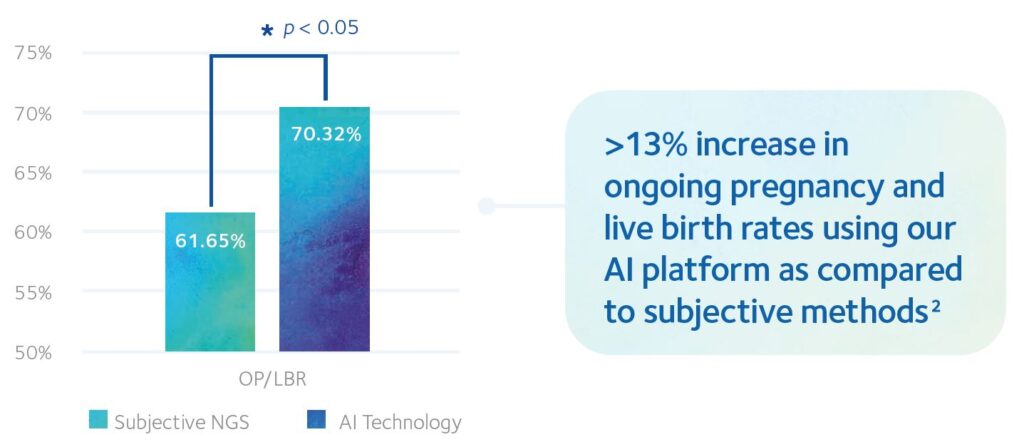
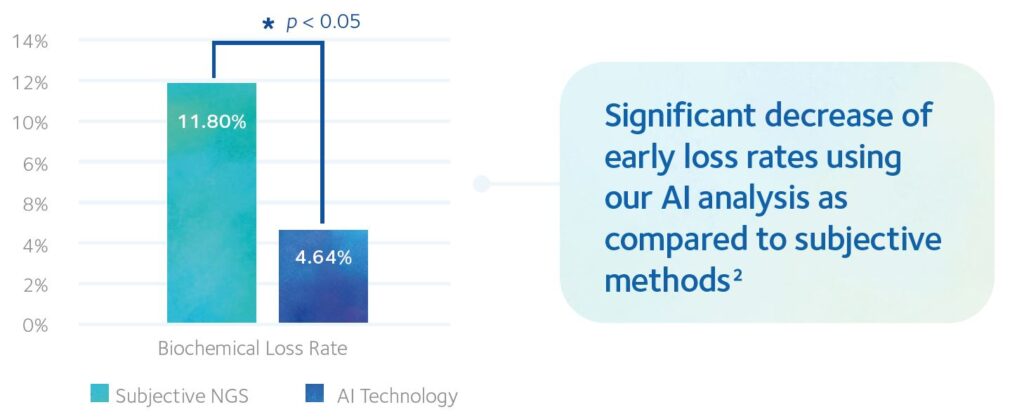
Our unique AI innovation improves the odds of pregnancy and IVF success
The only test using artificial intelligence (AI) based on clinical outcome data, eliminating subjectivity, and improving accuracy. Our PGT-A provides greater confidence in robust and accurate results with two independent analyses (CNV and SNP) to check for abnormalities.³
Parental QC*
Patients are seeking reassurance of the parentage of their embryos
Today’s IVF patient is more educated, motivated, and involved in their treatment than ever before. Patient concerns about ensuring the parentage of their embryos have been raised due to highly-publicized reports of IVF mix-ups.
The new Parental QC assessment included in the PGT-Complete analysis confirms a match** between the embryo biopsy sample and the provided parental samples. This reduces the anxiety of potential mix-ups for you and your patients.
* Parental QC is not reported in countries (e.g. UK) where it is not permitted by regulatory bodies.
**A match is defined as a genetic analysis that is consistent with a shared inheritance and familial relationship between the parental samples and the embryo biopsy sample.


Empower
Empowering your teams and your patients.

Genetic PN check
Empowering additional embryo transfers
We understand that visual inspection of correct embryo fertilization is challenging, as
- PN may appear at slightly different times
- PN may be faint or have already faded
- A micro PN may be apparent
- PN may be vertically stacked making identification difficult. Our PGT-Complete test not only confirms correct embryo fertilization, it also enables testing of morphologically identified 0, 1 and 3PN embryos. This empowers your embryology team by allowing more embryos to be tested and therefore considered for transfer.
Let us provide your team with genetic information of correct embryo fertilization.
Arming your teams with the ability to identify and rescue true 2PN embryos, thus enabling additional embryo transfers.²
Origin of aneuploidy
Empowering your patients
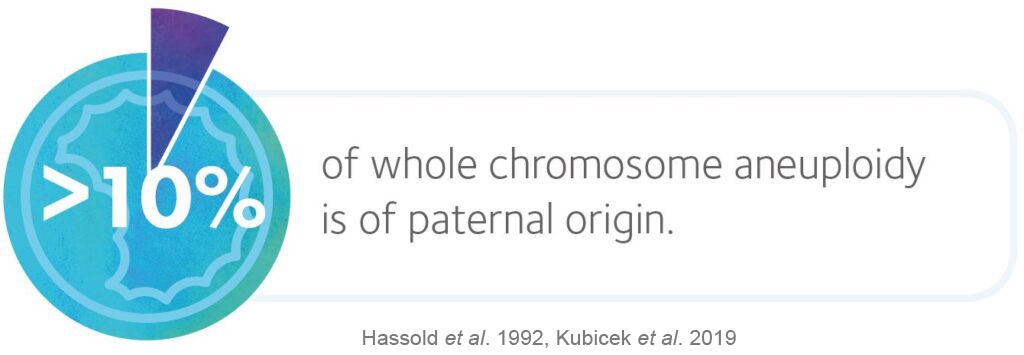
The origin of aneuploidy feature included in our PGT-Complete analysis provides a direct assessment of gametic contribution to embryo aneuploidy, helping your patient make informed donor gamete decisions.
For patients considering donor gametes it is important to understand that not all aneuploidy is maternally derived, as often paternal contribution to aneuploidy can be overlooked.


Simple test process
Designed with the patient in mind every step of the way
At CooperSurgical, we recognize that each sample that comes through our laboratory belongs to an individual or family with their own unique story and journey. We take a personalized approach to patient care and clinical service.

PGT-Complete selected on test requistion form

Embryo biopsy and parental cheek (buccal) swabs collected and shipped to a Cooper Genomics Laboratory

Samples analyzed and reported back to the clinic

Genetic testing consultation is available before or after testing
Brochures, Catalogs & Flyers
Reproductive Genetic Testing Brochure
Reproductive Genetic Testing Brochure
PGT-Complete Brochure
PGT-Complete Brochure
PGT-A Patient Brochure
PGT-A Patient Brochure
PGT-A Clinician Brochure
PGT-A Clinician Brochure
PGTai White Paper
PGTai White Paper
1. JBRA Assist Reprod. 2020 Apr-Jun; 24(2): 143–146. Blastocysts Derived From 0PN Oocytes: Genetic And Clinical Results
2. Buldo-Licciardi J, Large M, McCulloh D, McCaffrey C, Grifo J. Second generation artificial intelligence technology for preimplantation genetic testing (PRT) improves pregnancy outcomes in single thawed euploid embryo transfer cycles (STEET).
Presented at American Society for Reproductive Medicine on October 19, 2020. Available at: https://asrm.confex.com/asrm/2020/meetingapp.cgi/Paper/8645. Accessed Feb 18, 2022.
3. CooperGenomics, internal data on file.
PGT-Complete (parentage testing) is a genetic test intended only as a screening and quality control tool, and includes Parental QC and Origin of Aneuploidy analysis. It is not a diagnostic test and does not guarantee gamete contributor identity, embryo health or fertility outcomes. Healthcare providers should review the test’s indications, limitations, and potential risks and discuss these with their patients to determine whether the test is appropriate for the patient’s individual circumstances. Parental QC (parentage) compares the DNA in an embryo sample to the DNA samples provided by the gamete contributors to provide reassurance the intended gametes were used in embryo formation. It is not a legal parentage or identity test and cannot prevent or detect all possible errors. Origin of Aneuploidy analysis looks at whether a chromosome change derived from the egg or the sperm. This information is not definitive and does not predict future fertility outcomes or guarantee results in future cycles. Genetic PN (pronuclei) Check is a genetic analysis that helps support evaluation of whether fertilization occurred in a typical manner. This test is intended to provide supportive information only and does not confirm embryo viability, health, or likelihood of pregnancy. Genetic testing cannot guarantee pregnancy or the birth of a healthy child.
Get In Touch With Us
We’d love to hear from you. How can we help?