

Preimplantation Genetic Testing for Monogenic Disorders (PGTM) is a genetic test intended only as a screening tool and is designed to look for a specific genetic mutation known to run in a patient’s family, helping identify embryos that are not affected by that condition. It is not a diagnostic test and cannot detect all genetic mutations, abnormalities, or health conditions. Genetic testing is complex and continually evolving, therefore it is recommended that you speak with your healthcare provider to understand if this testing is appropriate for you.
Right Embryo
A genetic test designed to reduce the risk of having a child with an inherited condition

What is PGT-M?
For people who know they are at increased risk of passing on a specific genetic condition, PGT-M, or preimplantation genetic testing for monogenic/single-gene defects, can be performed prior to embryo transfer to greatly reduce the risk of having a child affected with that condition.
PGT-M for single gene disorders involves testing embryos created through in vitro fertilization (IVF) and then transferring unaffected embryos. PGT-M was formerly known as PGD, preimplantation genetic diagnosis.
How it works
PGT-M tests are created uniquely for each family. PGT-M can be performed for nearly any single-gene disorder as long as the specific familial mutation has been identified and appropriate family members are available for test preparation.

PGT-M can be performed for >99% of inherited single-gene disorders

PGT-M identifies affected and unaffected embryos with >99% accuracy
Who is PGT-M for?
PGT-M is appropriate for people who are at high-risk of passing on a specific single-gene disorder. You may consider PGT-M if:
- You and your partner are carriers of the same autosomal recessive condition (e.g. Cystic fibrosis)
- You are a carrier of an X-linked condition (e.g. Duchenne Muscular Dystrophy)
- You or your partner have an autosomal dominant condition (e.g. Huntington disease)
- You or your partner have a mutation associated with a hereditary cancer syndrome (e.g. BRCA1 & 2)
- You had a child or pregnancy with a single gene disorder
- You want to perform HLA matching
The PGT-M Process

Case review
Ordering provider submits a TRF along with genetic testing reports for case review and approval.

Genetic consultation
Registered patients speak with a genetic counselor
(PGT-M: discuss if additional genetic testing of the couple or other family members is required).

PGT-M process
PGT lab collects DNA samples from the couple and appropriate family members and designs a test unique to each family.

IVF
In vitro fertilization is performed and the resulting embryos are incubated.

Embryo biopsy
An embryologist carefully removes a small cell sample from each embryo.

Vitrification
Embryos are frozen while awaiting PGT results.

PGT-M
Biopsied samples are sent to the PGT laboratory, testing is performed, and results are released to the IVF center.

Embryo transfer
If available, a chromosomally normal embryo is selected for transfer. Additional euploid embryos can remain frozen for future use.
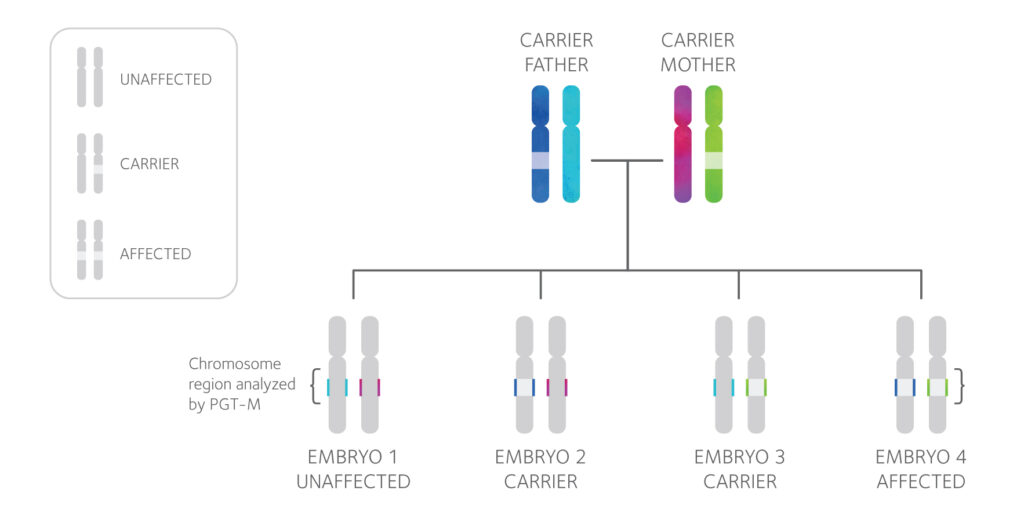
PGT-M Technology
PGT-M testing involves a close examination of both the mutation an individual carries and the area of the chromosome surrounding it, shown above as the colored segment of each chromosome.
Each PGT-M test design is unique and specific to the family, so DNA samples from both partners, and often additional family members, will be requested in order to design a test.
Then, linkage analysis is used to determine the “genetic fingerprint” of the mutation and diagnose each tested embryo as affected or unaffected.
PGT-M/SR Experience
CooperSurgical is the pioneer and worldwide leader of PGT-M/SR. Our experts have over a 100 years of combined PGT-M experience and global expertise in providing accurate results – highlighted by our ability to accept the most complex of cases.
Because PGTM is customized for each family, it only evaluates for the single-gene variant(s) for which testing has been ordered. It does not evaluate for sporadic chromosome abnormalities or for any other genetic disorders. It does not guarantee the birth of a healthy baby. Medical guidelines and healthcare providers recommend that any pregnancy resulting from an embryo screened with this test undergo confirmatory diagnostic testing, such as chorionic villus sampling (CVS) or amniocentesis, to verify genetic status.