

Wallace® Trial Transfer Catheter
Confident positioning of the outer sheath before introducing the embryo loaded inner
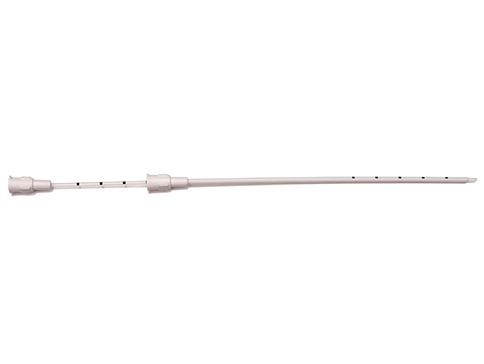
Key Features of TT1816 and TT1816N
- Trial transfer catheters allow for confident positioning of the outer sheath before introducing the embryo loaded inner. Clinicians have found this technique to have a positive impact on pregnancy rates 6
- Same soft material and smooth tip as the Classic catheter to minimise trauma
- Formable outer sheath to suit different patient anatomies
- Centimetre marking to show outer sheath depth and inner lumen protrusion for confidence of placement
- Fully compatible with the Wallace Classic Catheter ranges and stylets
- Also compatible with SureView® range
Key Features of CE418 and CE423
- Visible under ultrasound from hub to tip7
- Trial transfer catheters allow for confident positioning of the outer sheath before introducing the embryo loaded inner. Clinicians have found this technique to have a positive impact on pregnancy rates 6
- Same soft material and smooth tip as the Classic and Sureview catheter to minimise trauma
- More accuracy and confidence when positioning catheter tip within uterus before embryo transfer
- Formable outer sheath to suit different patient anatomies
- Centimetre marking to show outer sheath depth and inner lumen protrusion for confidence of placement
- Fully compatible with the Wallace Classic Catheter ranges and stylets
Product codes
| Product | Order Code |
|---|---|
| Trial transfer catheter blind end (18cm) – Quantity: 10 | TT1816 |
| Trial transfer catheter blind end (23cm) – Quantity: 10 | TT1816N |
| Trial transfer catheter blind end (18cm) ultrasound visible – Quantity: 10 | CE418 |
| Trial transfer catheter blind end (23cm) ultrasound visible- Quantity: 10 | CE423 |
Brochures, Catalogs & Flyers
Instruction for Use
Instruction for Use
7. Coroleu, B et al. (2006). “Effect of using an echogenic catheter for ultrasound-guided embryo transfer in an IVF programme: a prospective, randomized, controlled study” Human Reproduction. Advanced Access. doi:10.1093/humrep/del045
8. Wood, E et al. (2000) “Ultrasound-guided soft catheter embryo transfers will improve pregnancy rates in in-vitro fertilization.”Human Reproduction. Vol.15, No.1, pp.107-112.
9. Sallam, H et al. (2003). “Ultrasound-guided embryo transfer: a meta-analysis of randomized controlled trials.” Fertility and Sterility. Vol.80, No.4, pp.1042-1046.
10. Coroleu, B et al. (2000). “Embryo Transfer under Ultrasound guidance improves pregnancy rates after in-vitro fertilization.”Human Reproduction. Vol.15, No.3, pp.616–620.
11. Anderson, R et al. (2001). “Transvaginal ultrasound-guided embryo transfer improves outcome in patients with previous failed in vitro fertilization cycles.” Presented at Pacific Coast Reproductive Society. Rancho Mirage, California, April 25th-29th 2001.
12. Shamonki, M.I et al. (2005). “Ultrasound-guided trial transfer may be beneficial in preparation for an IVF cycle.” Human Reproduction. Vol.20, No.10, pp.2844–2849.
Get In Touch With Us
We’d love to hear from you. How can we help?